Blog


6mDB pics

Tuesday
03
April 2012

Historical Technology and Technique on the Double Bass

I recently stumbled on an old paper from an undergraduate research project I did over a decade, and thought some of you might enjoy it.

My professor at the time noted it has a slightly more “teleological narrative” than he would have liked. (I had to look that up, too!) I have to agree at this point; I think I was used to writing persuasive essays rather than research. Here it is, eleven years later anyway:


A History of Double Bass Technique


By Robin Ruscio

June 5, 2001

            The contemporary double bass is an often-marginalized string instrument, which only in the last half century has reached the expressive potential it is capable of on any sort of widespread level.  This is due largely to the development of technique on instrument, although other important factors such as technology, tuning, and performance practices have influenced its development.  The approach taken to the instrument has developed progressively since its beginnings.

The earliest double bass techniques were primitive and cumbersome.  It is important to remember that the earliest double basses, which first appear around the end of the 17th century, were very different from the ones used today.  The single most important difference was that the strings were made of gut, which was the chief material used on all string instruments until the after World War II.  The problems with gut strings were largely due to quality control problems; it was difficult to obtain strings of such enormous size as needed for the double bass that remained consistent in gauge throughout their entire length. (In the viol family, luthiers often sized their instruments according to what strings were available in the region they lived in.)  They tended to be harsh on the left hand (some bassists actually wore gloves to protect their hands), and required a much larger amount of attack from the bow in order to speak.  They were also extremely sensitive to temperature and humidity changes, which no doubt created tuning nightmares for early bassists.  It was also hard to produce the lowest and thickest strings necessary for the E string, which prompted bassists to opt for 3 string instruments during much of the 18th and 19th centuries.  The greatest bassists of the time, such as Dragonetti and Bottessini, custom ordered better strings from suppliers at great cost, although this was something few ordinary orchestral players could afford.

The push for a steel string first came about during World War I, when gut was in short supply because it was being used for sutures on the battlefield. The first all steel string set was first developed in Germany during the 1930’s, although it did not come into widespread use until after World War II.  The steel string presented several advantages to bassists.  It produced a brighter, more projecting tone.  It was consistent in gauge, and, combined with more mass production methods, was much more consistent in quality. It allowed for lower action (the distance of the string from the fingerboard), which was extremely beneficial to bassists attempting to master the highest register of their instruments.

The transition from gut to steel was not without controversy.  Some players felt that the gut strings produced a sweeter sound that was lacking in the more metallic sounding steel sets.  Some jazz bassists still use gut strings for their warmth, including such renowned bassists as Charlie Haden and Harvie Schwartz, who use gut on their top two strings and steel on the lower two.  Rockabilly and country bassists still prefer them when utilizing slap techniques, which can be rather painful on steel.  Period performers also prefer gut to authentically recreate early works, although most performers would consider it archaic to play Romantic and early 20th century works on gut, even though this is the sound composers were writing for at the time.  Still others point out that gut strings made today are of much higher quality then those players abandoned fifty years ago.

Keeping in mind the changes made to strings since the 17th century, the double bassists still utilized rather limited techniques, especially in the left hand.  One of the earliest approaches to fingering the bass was known as the fisticuffs technique, named appropriately for the fist like shape the hand took when playing.  The technique used only the first and fourth fingers at an interval of a half step apart, the idea being that the fourth finger needed the support of the second and third fingers in order to hold the string down.  The thumb was placed vertically on the back of the neck, directly behind the first finger (as opposed to the second finger, the norm today). Players also performed with the pad of their fingers instead of the tip. The fisticuffs technique no doubt limited velocity on the instrument, especially when compared with other string instruments that were already using all four fingers.  The technique later evolved to include two versions, a “closed” version identical to the previous description and an “extended” version, which had the interval of a whole step between the first and fourth fingers, although still omitting the use of the second finger in between.

Another reason for such poor technique was due to the low level of expectations for the instrument.  The earliest Baroque players were playing basso continuo lines which were not written for any specific instrumentation, and it was expected that double bassists would use there own judgement as to when to play and when to drop out, either for orchestrational reasons or because they simply couldn’t execute the line properly. Works from the classical era usually have parts for violoncello/bass together, with bassists sometimes asked to rest during melodic or more difficult technical passages.

Of course, these expectations began to change with the rise of the composer’s status in music during the early 19th century, particularly around the time of Beethoven, who wrote parts actually unplayable by even modern professional standards, such as the storm scene from his Pastoral Symphony.  Rather then being defeated by these demands, bassists rose to the level expected of them.  Not by coincidence, the earliest method books appear around the same time, as do double bass departments at the conservatories.  It also about the time we see the 3 finger per position technique appear, which is still the norm today.  Players began utilizing their first, second, and fourth finger in each position a half step apart, allowing for a whole step in each position.  Players were also expected to learn thumb position like their cello counterparts, allowing for the bass to reach ranges suitable for solo playing.

Modern day bassists utilize an even broader arsenal of techniques then ever before.  Amongst the most interesting are those developed by the French bassist François Rabbath.  Rabbath developed many of his unusual techniques largely due to isolation while growing up in the Middle East, later traveling to Europe to discover that he was both unorthodox and more skilled then the bassists there. Among his contributions are strong belief in the advantages of pivoting, where the entire hand position can be moved a whole step in either direction without moving the thumb, allowing for less shifting and therefore greater velocity and ease in playing.  He also uses the rather unnerving “crab” technique, which allows a player in thumb position to move his thumb while the other fingers are being used, essentially eliminating any kind of true shift altogether.  Rabbath also has furthered ideas related to weight distribution and effortlessness in regards to the body, concepts he calls “inert force”, which help in playing the extremely physically demanding instrument.

Rabbath is not the only virtuoso in recent times to contribute to the bass’s technical development.  Gary Karr, unarguably the most important classical bassist of the century, stunned the music world with his debut recording at the age of twenty in 1961.  He single handedly brought the level of expectation and possibility higher by demonstrating how effective the bass could be as a solo instrument.  He also utilizes some unconventional techniques, such as using all four fingers in the lower register, an idea he says he borrowed from electric bassists.  Karr’s bowing approach uses a very slow bow near the bridge, which gives him the beautiful cantible sound he is best known for.  Other contributors to the bass’s development include jazz bassists Scott Lafaro and Charles Mingus, the former of whom utilized a guitar like approach to his playing with an astonishing level of virtuosity and freedom.

When viewed as fluid construct rather then as a static entity, we can see that the double bass is not the oafish giant it is often thought of.  Instead, we see an instrument whose only limits have been the expectations of those that wrote and performed on it.  We can see that developments in technology and raw human creativity have brought it to heights previously unimaginable, and that it will undoubtedly continue to progress and be an important contributor to music in the current millennium.

Thursday
15
March 2012

Roscoe Fretless Bass Sample

Sample of my Roscoe Fretless for TB’ers.
M-audio USB interface into Garageband, no effects or EQ apart from onboard Bartolini preamp.

Fretless demo 2

First part– EQ Flat, Bridge PUP

Second part (Blues Walking)- EQ flat, both PUPs

Third “A Remark You Made”- Hi mid boost, treble cut, bridge Pup


And here’s the same bass with Nordstrand Dual Coils installed, roughly same settings and tunes!

Fretless demo– Nordstrands

And here’s a sample with the Nords “In the Mix”. Me on gtr as well. ;)

The Chicken — Fretless Nords


What do you think? Please leave a comment!

Tuesday
21
February 2012

My Pedal Board setup

I had to configure a new pedal board setup for the Six Million Dollar Band, and here’s what I settled on.

We use in ear monitors and no amps on stage, so it started with my trusty Aguilar Tone Hammer, which I use in almost all situations as a preamp and direct box. The gig required chorus on a few tunes (Don’t Stop Believing), and I just snagged the new MXR Analog chorus pedal, which sounds great. There’s also a few with distortion, and I sprung for a Darkglass  Microtubes B3K, which has an incredible full bottom while delivering as much grind as I could possibly want. I added my old MXR Phase 90 out and completed the setup with my Peterson Strobostomp, which is essential with the dark stages and long sets of continuous tunes.

I there the whole setup on a tiny Pedaltrain micro board, and it’s an easy grab and go instant rig. The cables are connected with George L’s cut to length and powered with a One Spot adaptor. Considering I don’t need an amp, this makes for a simple setup!

Tuesday
31
January 2012

Follow me on YouTube!

I have my own youtube channel that includes many of my own videos, and also will give my fellow low end lovers a chance to see some of my favorite youtube bass videos.  Please look for more of my own content that will include gigs, gear, and lessons!

Denverbass79


If you like what you see, please subscribe to my channel while you’re there.

Here’s my currently most popular video:

Monday
30
January 2012

Footprints with my Fodera

Here’s the Wayne Shorter classic “Footprints” from a late night recording session. I’m really enjoying my new Fodera and wanted to see how it sat in the mix with a bass line and an overdubbed solo/melody part. I find doing little projects like this helpful in helping me fine tune my tone and approach by listening back.

Fodera Footprints 3

Wednesday
25
January 2012

Sadowsky bass NYC 5 for sale– eventually

My Sadowsky 5 string 24 fret will be for sale when my new Callowhill is done in 4–8 months. If you’re interested, contact me and let me know and I’ll contact you when I’m ready to part with it. Specs on my gear page.


Monday
23
January 2012

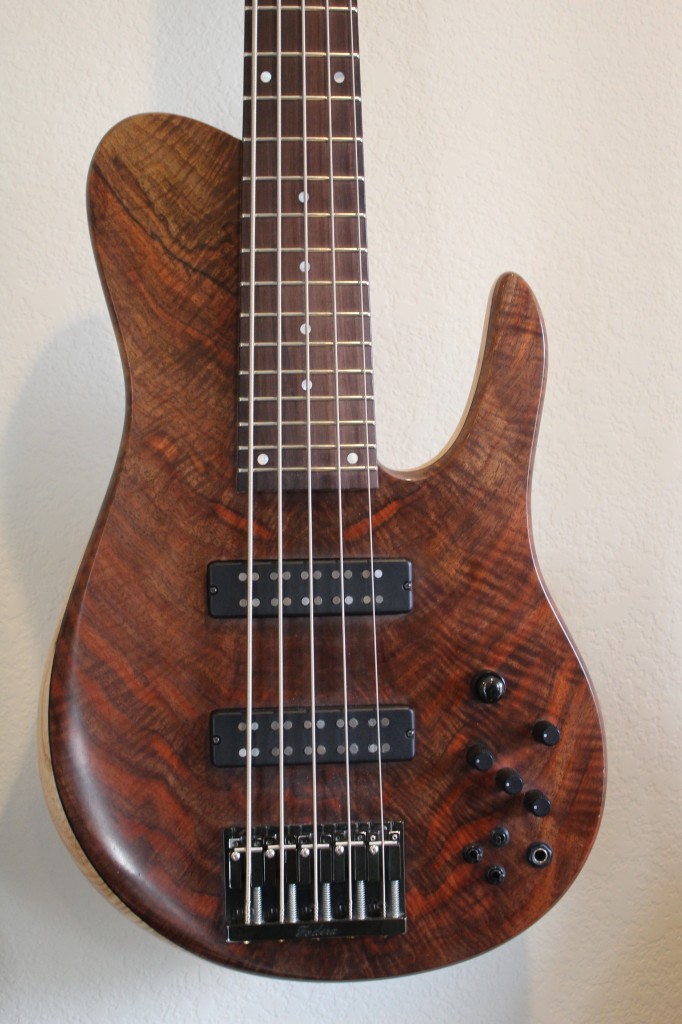
Ordered a Callowhill Junk 5 bass

My next electric in the jazz bass tradition will be a Callowhill Junk 5, made by Tim Cloonan in Philadelphia. Tim and I spent some serious time on the phone and I feel great about his building approach and philosophy; it was a delight to find a builder who had thought of a great number of details that were important to me. He can also source some amazing Brazilian Rosewood, which is CITES protected and not offered by many builders. Seeing one in the flesh a few weeks ago sealed the deal.

One of the biggest things that he’s improved the balance and reduced the weight of his bass, often achieving basses near 7 lbs that sound great and don’t have any neck dive. It will be really gig friendly and I can’t wait to get it! Should be 4–8 months.

Specs:

Junk 5

Chambered ash body

Flame maple top, dark cherry burst finish

Brazilian Rosewood fingerboard, no dots

Nordstrand Big Single or Big Split pickups, Sadowsky preamp

Black Hardware

One of the pieces of flame maple will be used for the top:

Monday
23
January 2012

Study On Strad Violins in NY times

Interesting read:http://www.nytimes.com/2012/01/03/sc…s-lags.html?hp

I’m with the violinist naysayers on this study, which is interesting but misses some things. You can’t judge an instrument until you’ve played in an actual musical situation, and often times the true character does not come out and become apparent until you’ve spent some time with it. It’s taken me weeks if not months to understand any instrument I’ve ever owned, which is why I’ve flipped so many.

I played one of the world’s best basses this year in my living room and used the Ferrari in a parking lot analogy myself.

That being said, I have no problem with playing a well made new string instrument, which is why my 100 year old bass is about to be replaced by one that is going to be made starting the end of this month!

Wednesday
04
January 2012

Joining The 6 Million Dollar Band– The Ultimate 80’s Experience!

I’ll be joining the The 6 Million Dollar Band for many of their shows next year.

The Six Million Dollar Band (6MDB to their fans) delivers high-energy 80s New Wave music using a combination of new and old technology. Five keyboards complement the guitar, drum and bass rhythm section, producing the classic sounds 80s fans love to hear. Vintage 80s synths deliver album-perfect sound. Tears for Fears, Duran Duran, Simple Minds, Depeche Mode and more are recreated faithfully and performed with the same energy as the original acts.

Watch the 6MDB Promo Video 

We have been rehearsing and I am really enjoying getting to revisit a lot of fantastic new wave and other 80’s dance tunes. (I haven’t had this much time with a pick in years!)

Come by and see one of the many gigs I’ll be playing with them this year:

12/30

More


Thursday
15
December 2011
Tagged